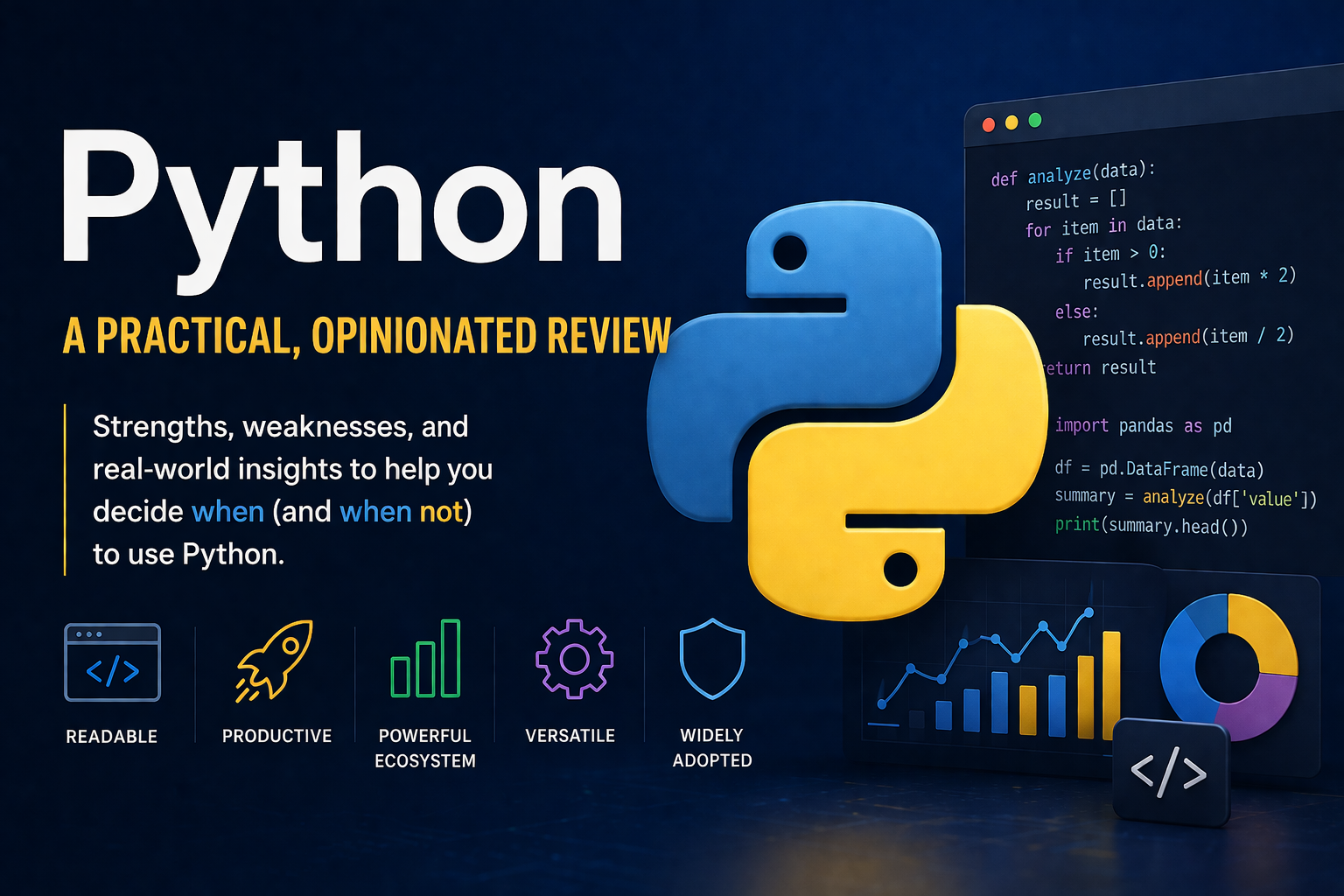
Python: A Practical, Opinionated Review
Overview
Python is one of the most widely adopted programming languages in modern computing. It positions itself as readable, expressive, and accessible—often described as “pseudocode that runs.” That reputation is largely earned, but it comes with tradeoffs that matter more as systems grow.
Where Python Excels
1. Readability and Speed of Development
Python’s syntax is clean and intentionally minimal. You can express complex ideas in very little code. For internal tooling, automation, and APIs, this translates directly into faster delivery.
- Minimal boilerplate
- Strong standard library
- Easy onboarding for new developers
In practical terms: if you need something working this week, Python is often the right choice.
2. Ecosystem Depth
Python’s ecosystem is not just large—it’s dominant in certain domains:
- Data science:
pandas,NumPy,scikit-learn - AI/ML:
TensorFlow,PyTorch - Web:
Flask,Django,FastAPI - Automation: scripting, DevOps, API integrations
For someone working across systems—as you do—Python becomes the glue language that ties everything together.
3. Versatility
Python is used everywhere:
- Backend services
- Automation scripts
- Infrastructure tooling
- Data pipelines
- Security tooling
Few languages span that breadth effectively. Python does.
Where Python Struggles
1. Performance Limitations
Python is not fast. Full stop.
- Interpreted execution
- Global Interpreter Lock (GIL)
- High memory overhead
If you’re building high-throughput systems, real-time processing, or anything CPU-bound, Python becomes a liability unless you offload work to C extensions or external services.
2. Weak Enforcement of Structure
Python gives you freedom—arguably too much.
- No strict type enforcement (even with type hints)
- Easy to write inconsistent codebases
- Architectural discipline is optional, not enforced
In small scripts, this is fine. In large systems, it leads to entropy unless you impose strong standards.
3. Dependency and Packaging Friction
Despite improvements, Python packaging is still messy:
pip,venv,poetry,pipenv—too many competing tools- Native dependencies can break builds (you’ve likely seen this with missing headers like
Python.h) - Version conflicts are common
Compared to ecosystems like Node or Go, Python still feels fragmented here.
4. Deployment Complexity (at Scale)
Python is easy locally but harder in production at scale:
- Slower startup times
- Higher resource usage
- Requires careful containerization and process management
It works well in Docker—but it’s not inherently lightweight.
Real-World Fit (Practical Assessment)
Strong Fit
- Internal tools and automation
- API backends (especially with FastAPI docs)
- Data ingestion and transformation
- Integration-heavy systems
Weak Fit
- High-performance services
- Real-time systems
- Low-level infrastructure components
Opinionated Verdict
Python is not the “best” language—it’s the most useful one.
It optimizes for:
- Developer time over machine efficiency
- Flexibility over strict correctness
- Speed of iteration over long-term rigidity
That tradeoff is exactly why it dominates in practical environments.
However, it requires discipline. Left unchecked, Python codebases degrade faster than those in more opinionated ecosystems.
Final Rating
- Ease of Use: 10/10
- Ecosystem: 10/10
- Performance: 5/10
- Scalability (engineering discipline required): 6/10
- Overall Practical Value: 8.5/10
Bottom Line
If you are building systems that integrate, automate, or orchestrate—Python is difficult to beat.
If you are building systems that must be fast, strict, and highly optimized—Python should not be your first choice.
Used correctly, it’s a force multiplier. Used carelessly, it becomes technical debt faster than most teams anticipate.